Overview
When the F.W. Urban League welcomed Vernon Jordan, National President and CEO, as a guest speaker for one its annual galas, the local nonprofit was fortified by seasoned board members and support staff. An assassination attempt on Jordan’s life after the event meant the world was watching how its local branch responded to the crisis.
The League redoubled its efforts on the job market, as Fort Wayne suffered through the beginning of an economic downtown that saw its most powerful industries and historic neighborhoods change profoundly.
Listen and Learn
Listen to the original recording of this historic session and follow along with the full transcript. Experience the moment as it happened with both audio and text for easy reference.
Transcript
Synovia Brown
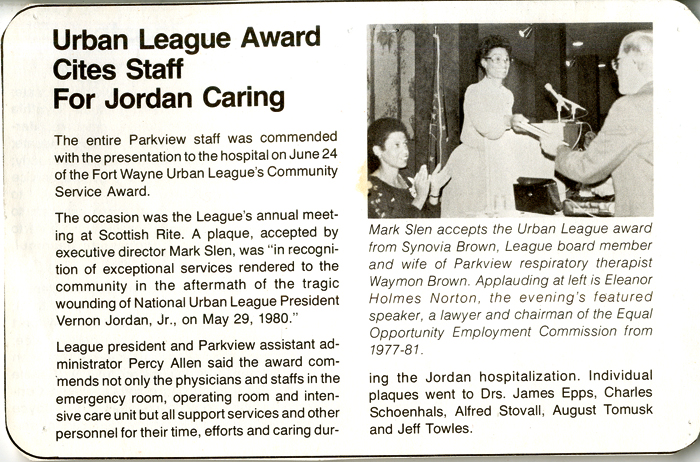
I think Fort Wayne was beginning to be thought of as a very good place for the national to take a look at. I think the UL was doing some pretty good things. We had Eleanor Norton Holmes, we had lots of speakers coming in.
Denise Porter
We were very involved with the socialization sort of thing, the pulling together for social events, which gave us funding so we can do other things. For example, one of the things that was very, very prominent in this community in the 70s was something they called the Black and White Balls. It was a gala event; it brought in money. Men and women were encouraged to wear either black and white. It was an integrated opportunity to showcase what was the best in the African-American community.
The best ones was actually held at what used to be the old Southtown Mall; 500 to 700 people all dressed up, all fancy. Sometimes you would have a Debutante Ball and you would present the next generation and things of that nature. That was the soft way that the Urban League could get its message of inclusion, reaching for higher heights, in a way that the people who could fund those things feel they were part of the difference.
When I was a college student when I was with the Urban League, actually I was there when Vernon Jordan came to town.
J. Synovia Brown.
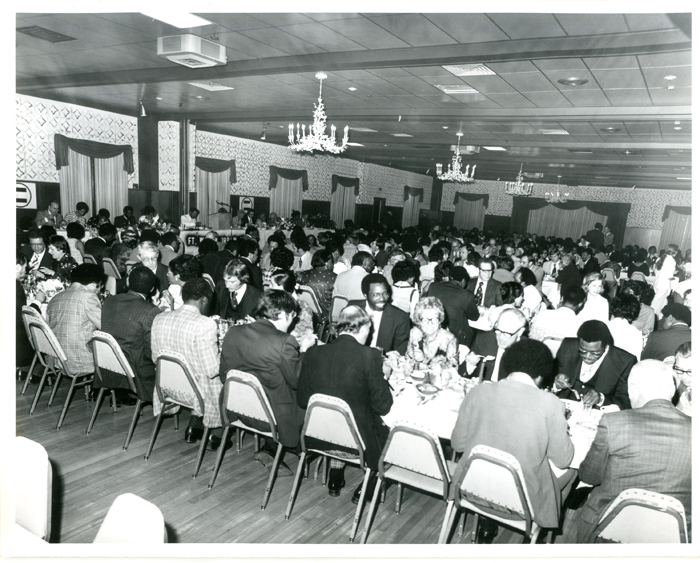
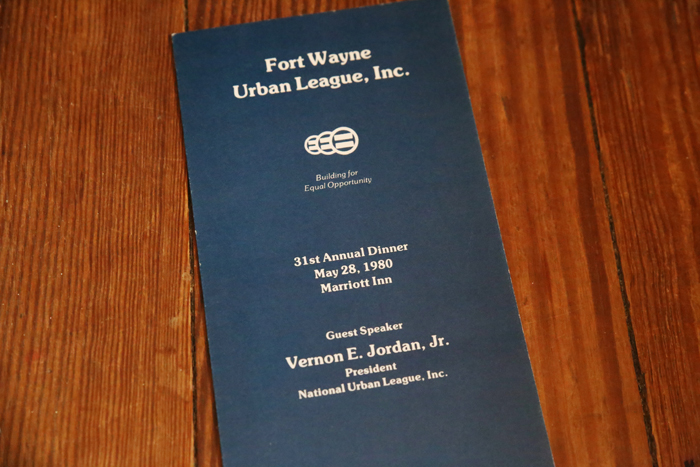
It was the 31st Annual Dinner and it was held May 28, 1980 at the Marriott Inn.
Mary Barksdale
And it was a big affair; there were several 100 people there. Synovia Brown and I were both on the Urban League board.
I believe it was Synovia that convinced the board to ask Vernon Jordan, who was the executive director of the National Urban League, to be our guest speaker.
We did all kind of things to raise money.
Synovia Brown
We were so happy that Vernon Jordan was coming to Fort Wayne.
And it was like our other programs, we had speaking, we had a dinner, and then Vernon Jordan spoke.
Mary Barksdale
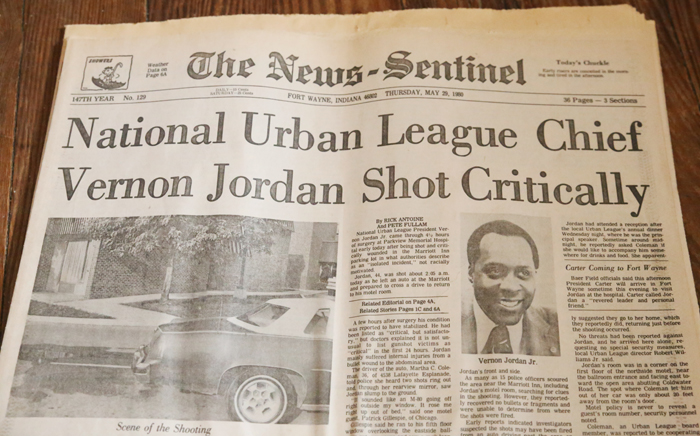
It was a great evening. I was probably home that evening around 11 o’clock. And about 5 o’clock in the morning I received a phone call that Vernon had been shot.
So I was a Parkview board member and I could go in the backdoor. I went out to the hospital, I wasn’t able to get in anywhere that was close to him or what was going on, but I was able to find out from the officials there what had happened.
Synovia Brown
I couldn’t believe it (laughs), like: We just saw him.
The assassination attempt took place outside the side entrance of the hotel. CNN covered the shooting in their first telecast, on June 1, 1980. When a visiting President Jimmy Carter walked out of Jordan’s hospital room, CNN was live.
What the Board did is have just certain people from the board to be at the hospital and decide who was going to be accepted because they couldn’t just have people running in, going back to Vernon.
I remember Senator Ted Kennedy coming in.
And they got national recognition for that.
Mary Barksdale
And Vernon had been shot while he was with an International Harvester female employee about 1 o’clock in the morning. This was a lot of publicity for International Harvester. This was a lot of publicity for the world.
Dr. Jeff Towles in Fort Wayne, Dr. Al Stovall in Fort Wayne, they were the doctors who saved Vernon’s life. I think they remained friends for many, many years.
This was a very disturbing time and it went on for a number of months. But Vernon survived. It was a wonderful affair and it ended in a devastating way. But we survived that. The UL survived that.
Denise Porter
When the neighborhoods began to go further and further into the suburban area, one by one, some of those stores would close down. But if you see between the 70s and the 1980s, almost half of the stores are leaving to go someplace else. You kind of think well okay I don’t know what’s happening.
Things that just seem to be a slow drip, drip, drip came like a monsoon as things were pulling out of the community.
It began to give feelings of something’s not quite right here.
The Urban League, the NAACP, the media, the churches all began to look at some of those areas probably for the first time collectively as you got into the late 70s, 80s, and 90s. Where you really saw things change was after Harvester closed down in the Fort Wayne because not only was this a poor black thing it was poor whites. Everybody was filling the pinch.
Mary Barksdale.
International Harvester produced heavy-duty semi-trucks and light-line trucks.
Aisha Arrington
The Fort Wayne Truck Plant One was once called the heavy-duty capital of the world.
Mary Barksdale
I was hired at International Harvester in June 1964 one month before the implementation of the Civil Rights Act.
At that time, GE and International Harvester were the two biggest employers in Fort Wayne, International and GE had about 10,000 employees each.
My entryway into the Urban League was through International.
The Urban League had a number of board members, some of them were minorities, some of them were managers. And they used that influence in working in the community.
So I served as the International Harvester board member for the Urban League.
I thought it was a serious loss to the community, but that was a loss of families. The one thing I remembered about that, one of our purchasers suffered a nervous breakdown and he came back and killed his family. I never forgot that.
Aisha Arrington
The International Harvester Fort Wayne closed on July 15, 1983, after sixty years.
Joanna Patterson
My aunt put together some information about Westfield growing up in Westfield. She said: For many local African Americans, the term Westfield–also known as the rolling meal district as I said–sparks a flood of emotions and memories.
In the early half of the century, black folks, mostly from Post-Civil War Alabama, along with Romanian (and I remember them), Hungarians, Syrians and other, and sometimes later Mexican immigrants, began to build a community. The reasons were simple. They were good paying jobs.
I believe Westfield started to break apart in the 80s, when the steel mills started buying property around them, some people had to move, so that was part of it.
My name is Joe Jordan.
I am the President and CEO of Boys and Girls Clubs of Northeast Indiana.
Joe Jordan
500 members come to the Boys and Girls Clubs everyday.
80 percent of my kids are minorities.
We didn’t get to where we are by ourselves somebody helped us.
I grew up on the corner of Lafayette and Masterson, right down the street from the Reservoir.
Dr. Graham was the neighborhood doctor.
He was always a guy that always had this professional persona about him.
Eventually we moved out. Weisser Park, was definitely an upgrade.
I remember Mr. Barnes had a grocery store at the Old Pontiac Mall. Mr. Hearn who sold insurance, dressed well. He influenced me to think about business.
When I got out of college, I took a job with the Urban League back in 1986 or so. At the time, there was a gentleman by the name of Frazier… he was the CEO, and hired me to come in and try to revamp the employment program so I was the director of employment and training.
All those general labor type places where you can walk in and make you know $25, $30 an hour, they were not there. There were some really good jobs where you can make good money; they just were not as high profile as those big International Harvester type jobs. So that was our jobs, to go out and build relationships with nontraditional places, particularly probably never even hired African-Americans at all.
Jobs in areas that you wouldn’t think of, like welding plants, that paid good money but nobody knew they were back in the corner.
It went from general labor to professional placement. It was High-level executive people that they were looking for and we got ‘em.
Jonathan C. Ray.
Employment and housing are key and important to a parent being able to support their child. So having a robust employment program is to me a big part of what the Urban League is.
Carol Cartwright
You know the Urban League has always had one of its program area and focus is on education
Condra Ridley
My name is Condra Ridley.
Primarily, I’m known as a librarian because I worked for Allen County Public Library for 28 years straight and as a storyteller.
Maybe mid-80s, 85. Through the 90s, I did a lot of projects where we would go into the Urban League and work with their youth, doing Read Alouds with them, offering Summer Reading Program.
Originally, Pontiac Library was located at 3304 Warsaw, which was really close to Oxford so we were quite a distance away.
The Urban League was of course just a little distant, still downtown.
When the library was in the residential area on Warsaw, we were buried, kind of buried. It’s like you had to want to come to that library, to come there. It’s not a place that you would stumble upon. Once they moved it to the corner of Hanna and Creighton, that gave it greater visibility, easier access, and then people who were at the Urban League, or maybe even people who were at the library, we could kind of utilize those same people, that same clientele, it gave them more things that they can take care of, having the library and the Urban League right there close together.
Next Stop on the SoundWalkOur Sponsors

Additional Funding by Ambassador Enterprises, Lincoln Financial, and Downtown Improvement District.
Download the SoundWalk App
Download the app to experience the interactive SoundWalk, a location-based journey that brings historic Black Fort Wayne firsts to life at the Fort Wayne Urban League.